Production

More Wild Weather Expected

Heat-WaveI am sure you all are saying the same thing at the coffee shop… “is it hot enough for ya?”

Without a doubt it has been a wild weather year here in Minnesota!  With the April & May snow, slow start to summer (not getting here until mid-June!) and then we did get a nice 6 week stretch until again an unusual cold snap hit our area.

Now, here we are again in “summer” temperatures.  It is expected that we will have 90 degree weather right through Labor Day.  The blame for this late summer heat wave they say is a climate induced jet stream, and when this happens it can get “stuck” for weeks at a time.

How has the wild weather like the heat affected your progress up to today?  Did you do what you could possibly do to put this year’s crop in the correct stage to combat this current stress we are facing?

It is times like these, during extreme weather changes that we must be careful what we wish for, just 2 weeks ago everyone was worried about the heat needed to develop the crop up timely.  Now everyone is wishing for it to cool down to slow down the progress!

When it comes to predicting weather it’s considered a law of extremes.  We can only hope we have an average fall.

Read more about The Controllable Factors of Farming, Click Here.

Investigation is Key to Yellowing Corn Crops

We got the rain we needed but I am noticing that the canopy is turning yellow on my corn crop.

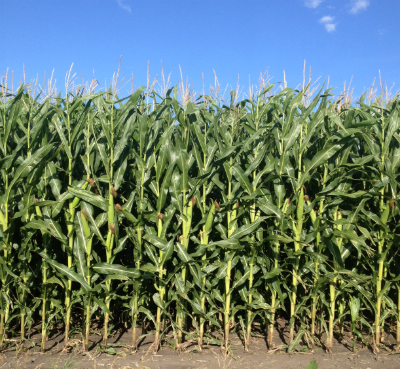
When farmers drive by corn fields they often keep a keen eye as to what is going on in each and every field.  More times than not, when something that is less than desirable is found, which is usually in their neighbors fields, the coffee shop conversation usually goes something like;  “Did you see farmer Bob’s corn field up on the county line?”  “Jeepers, what do you think happened there?”  While many thoughts are focused to finding out the one variable that caused an undesirable outcome of how the crop looks, more times than not after an in-depth investigation into the who, what, where, and why of the outcome, what is reveled  is that there was several variables that have led to a undesirable looking field of corn.

When we see positive results in farming, we do our best to replicate the scenario in future years.  When something negative occurs, we look to change something to make sure the scenario does not present itself in future years.  There is one inherent problem with this train of thought, the lack of investigation into what caused it.  Investigation only occurs when something bad happens, there is often no investigation into what happened to produce a positive outcome, and we just simply tell ourselves we were right.  It is this investigation process that is so important, in both positive and negative outcomes.

Corn plants and the soil we farm do an excellent job of prognosticating future pit falls that will occur in our growing season.  Whether it is a visual sign

  • From the corn plant
  • A tissue sample of the plants nutrients
  • Or a soil sample of a field

We have the ability to tell what is currently going on, as well as what will go on in fields, with a confident degree of certainty.  Agronomic decision’s that are made in season are often measure at the combine.  In-action on a decision is rarely measured, only the practices that were applied are measured. This occurs because of our basic belief that a yield monitor measures our progress.  However, it is my belief that the best way to measure certain applications is with visual interpolation, as well as plant and soil data.  To measure an in-season application at the combine is hard to conceptualize because there are other variables that may have affected the outcome of the crop, after the application was made.

As your operation prepares for harvest make sure you review what you were happy with this year, as well as your concerns.  Turn you set backs into comebacks next year with the things that you were unhappy about.  Every day in every field there is something to learn.  With the help of a trusted advisor and proper investigation you can turn this ……
BAD

Into this…….

GOOD

It all starts with re-affirmations of your agronomic plans as well of the re-education that takes place each and every year when given the proper tools to investigate how your crop handled the variables that were both in your control and out of your control.

Controllable Factors of Farming

As the growing season continues, we have started to see some weather events that may have affected the success of our stands through: drought, excessive rainfall, hail, or wind damage.  These events are bound to happen every summer but are completely unpredictable as to where they will occur, when they will occur and to what extent.  Damage from weather can be extremely frustrating, but it also brings out the importance of the factors we can control in farming.

These important controllable factors are connected to the decisions made in the months prior to the growing season as well as throughout the growing season.  One of the most important influences of a stand is the speed and depth at which the crop was planted.  Stands planted too fast can cause an increased amount of skips and delayed emergences, which will drive down the plant per thousand count.  The depth at which the seed is planted can also cause problems if it does not meet the proper depth.  Tillage practices can play a big part in the success-fulness of the stands.  Delayed emergences can become more prevalent if tillage practices are not effectively executed.  Residue such as root balls and chopped stalks from previous growing seasons can affect root growth if left in the seed trench.  Improper care for the ground may also leave tight sidewalls along the seed trench, which inhibits the seeds ability to grow strong and healthy roots.

Although unpredictable weather may seem extremely frustrating and a hindrance to success, we must continue to keep our focus on the things we can control.  If we spent all of our life worrying about freak accidents that could potentially kill us, we would go nowhere in life.  The same can be said about farming.  Instead of focusing on the damage Mother Nature can produce, we should focus on the positive things we have done, and the things we can improve on in our journey to becoming the best growers we can be.

Reed Nelson

Remember the Top 5 Factors to Producing a Top Notch Crop This Spring

Spring is here and I am sure you are all already to roll.  Remember the top 5 factors to producing a top notch crop?

  1. Soil conditions at planting.  Be sure that soil temps are above 55 degrees and moisture levels are adequate.  Soil conditions at planting are the most important factors when growing a top notch crop.
  2. Seed Placement.  Consistent seed to soil contact along with correct depth placement is critical for identical emerging.
  3. Seed quality.  Do you know the actual germination of the varieties you  have chosen this year?
  4. Right variety in the right field.  As you finish up your spring preparation,  be sure you follow the crop plan.
  5. Post planting management.  Be sure to be proactive;  with agronomic decisions such as herbicide, insecticide and fungicide applications throughout the year.  Do not be reactive!

Questions on how to implement these factors?  Leave a comment below or contact us today!

Have a safe planting season!

Five Factors to Produce a Top Crop

Spring is just around the corner and soon we will be back in the fields.  To prepare for this spring, we want to talk a little about minimizing the effects of 1,000 variables that Mother Nature will throw at you.  Controlling the 5 factors listed below will set your operation apart from the others each and every year!

  1. Soil conditions at planting
  2. Seed placement
  3. Seed quality
  4. Right variety in the right field
  5. Post-planting management

Soil – What are the ideal conditions to plant into?

Knowing when the soil is perfect takes both the science of seed and soil.  An old rule of thumb was to plant your crop based on the calendar.  While it is important to get your crop planted in a timely fashion, nothing is more important than the conditions you plant into.  Corn will yield the best if planted when soil is 50 degrees or higher, with a steady increase of temperatures in the forecast.  Perfect soil conditions start with the first tillage pass.  The ground must be level and firm.  The residue must remain sized and high in the soil column to keep it out of the seed trench where it can disrupt germination.  Ensuring the seed trench has good tilth, is not smeared, and is closed effectively will help in producing a great stand.  It is always better to wait 24 hours for better soil conditions than to simply push the envelope and cross it off the list.  You only get 1 chance to plant the crop per year and patience pays in the form of yield!

Seed Placement – What is the ideal depth to plant?


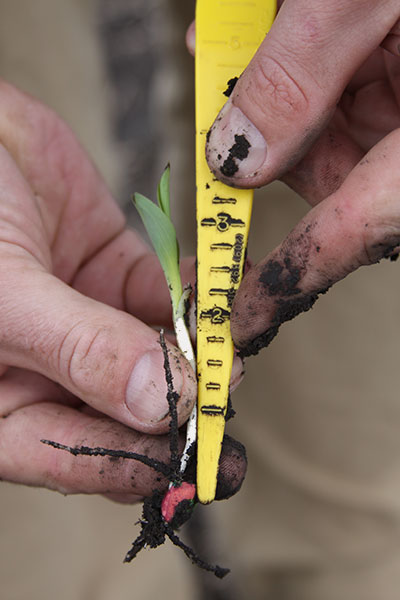
Depths of 2 – 2.25 inches are most favorable for corn.  Be cognizant of your speed as over 4 miles per hour could result in too much fluctuation in depths due to row unit bounce.  Uneven planting depth will lead to uneven emergence.  Keep in mind that a plant that emerges 24 hours after others will never catch up or produce to its fullest potential! Depths of 2-1/4” will ensure that the corn plant grows its full set of nodal roots and can handle the stresses and needs of the growing season.

Seed Quality & Matching the Right Variety to the Right Field

Starting with the right seed for your soil conditions is only the beginning. As you know, you can’t control Mother Nature.  How you handle what she gives us is the one thing you can control!

It’s not just about picking the right genetics; it’s about matching the right germplasm to the right field as 75% of all varieties never perform to their potential because they are planted on the wrong piece of ground.

If you have started with high quality seed, you must not place it in harm’s way!  The first 48 hours that the seed is in the ground are the most important.  Planting into suspect conditions, ahead of a cold rain, or in wet soils with residue in the seed trench will sacrifice even the highest of quality seed.

Post-Planting Management – After the planter is in the shed.
Proper post planting management starts with a plan!

We will address some of the challenges and strategies in our April Blog.

Do you have questions on how to increase your production as you nurture your field this growing season?  Ask us below or Contact Us today!

« Previous Page
Next Page »