General

Everything That Happens Above Ground Starts Below Ground

What is NEPS and how do you calculate it?

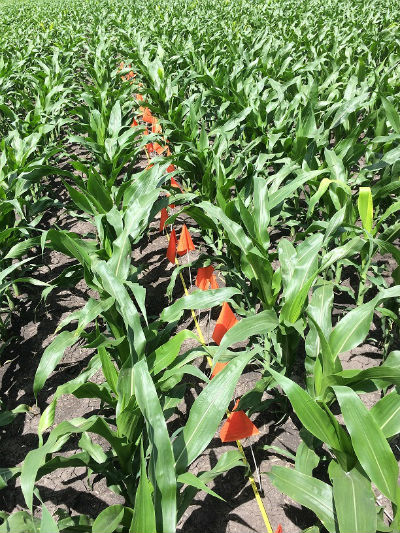
Net Effective Plant Stand (NEPS) is the total plant population minus late emerging plants and poorly spaced plants. The percentage is NEPS divided by total plant population. Typically this measurement is collected when plants are at the 4-8 leaf stage.

Most people look at a plant population once the field is planted; however, we analyze how many of those plants are actually full producing plants. Raising corn is no different than raising hogs. If you have a runt pig, it will always be a runt pig that doesn’t produce to the fullest potential while still using the same amount of resources to do so. Much like runt pigs, delayed emerging corn plants are stealing your profits.

Why is it important for our customers to look at NEPS each year?

Each year at CCI we look at NEPS for every field that a grower plants of our product. This is important for a grower to see and understand how tillage, seed quality, soil conditions, and residue management affect their plant stand of corn. We then use all of this information that has been collected to help growers make changes to their operation and their farming methods to ensure that they are making progress on improving their profitability while improving their skills in the field.

Why are NEPS important for us at CCI to look at?

We use NEPS as a catalyst for change. There are over a 1,000 variables that go into raising a great crop. Most variables are out of our control, but as we often say, the person who controls the most variables that they actually have control over will always out produce their competition. As a company, we can control seed quality, and we do so with very stringent testing of our seed not only at our conditioners, but also once it enters our warehouse. Before a bag of our seed is delivered to a farmer, it has been tested a minimum of 3 times at 3 different labs to ensure that it is the highest quality seed.

Understanding the genetic makeup of the hybrid is key to placing it on the right piece of ground. The right hybrids on the right piece of ground are two factors that can help you take your yield to the next level. Here at Corn Capital Innovations, we pride ourselves in helping production experts as yourself take high quality seed and place it on the right acre in your field.

Remember, everything that happens above ground starts below ground!

What did we see this year in the fields?

The 2014 growing season will be remembered in large part for the challenges that occurred in getting the crop planted in a challenging spring, as well as, the deluge of water that occurred in June. When we conducted our NEPS evaluations this year, here is what we saw:

  • Soil Conditions at planting time are the #1 dictator of yield
  • High full producing ear counts (best stands we have seen in the last 3 years)
  • Significant differences on vertical tillage versus field cultivators
  • Vertical tillage had a 2-3,000 full producing plants per acre advantage
  • The field cultivator smear layer kept the soil anaerobic longer than vertical tillage tools thus the plants suffered more seedling diseases as well as prohibited root development

Check out these pictures of what we were seeing in the field!

In agriculture, growing smarter begins with collecting knowledge from hands on experience and our agronomists can work with you to get the latest technology that’s right for your unique growing challenges.

So now is the time to start planning for 2015, contact Corn Capital Innovations today to get a crop plan in place or update your current plan for the coming year!
Farming is Like Playing Cards

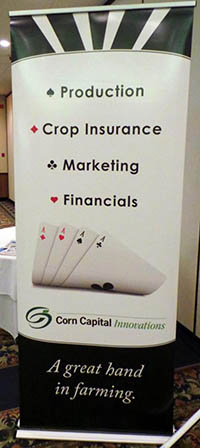
Farming is like Playing CardsI have heard that farming is a lot like playing cards. There is always a certain amount of risk involved and there is often a lot of money at stake. The only difference between playing cards and farming is that you cannot fold your hand when farming…..you have to work with the hand that mother nature has dealt you.

That is where Corn Capital Innovations comes in. We help you to optimize your control of the table through the four components of farming: production, crop insurance, financial analysis and grain marketing. You shouldn’t ever have to bluff your way to a better year. We better the odds that make farming a bit of a gamble.

Even though mother nature is constantly shuffling the deck we’ll help you feel more comfortable with whatever may come your way.

Working with Corn capital Innovations is like having a couple of wild cards in your hand so you can raise the pot in the world series of farming.

Want to learn more on how we can help? Contact Us today and we’ll make sure you’ve got the wild cards in your deck.

Life tends to be a road of continuing education…

AgEdge Education SeminarFarming is the same way.

Farming is not an industry of doing one thing a thousand percent better.  It’s an industry of doing a thousand things one percent better.  That’s where we come in.  We understand that farmers work with very tight profit margins, there’s little room for error.  We help your implement improvements in each area of your operation.

When those improvements are done together, it improves your bottom line.  Corn Capital Innovations is an educational hub for producers to be constantly challenged and informed on how to break yield barriers each and every year.

Learn more about Corn Capital Innovations and how we can help develop a continuing education program for your farm.  It’s the key to success in farming.

Connect with us on Facebook, check out our blog or give us a call today at 320-523-2252.

Check back often as we will be sharing details for the 2014 Water Street Edge Business Seminar as well!

Are You Relaxing and Enjoying the Summer?

Relaxing SummerWhat are your Summer plans?  Hitting the lake with your family and friends?  Taking some time try out your golf game?  Maybe fishing is your way to wind down?
At Corn Capital Innovations of Olivia we believe in the relaxing feeling of a summer breeze while sitting on the shore of your favorite lake.

We also believe that farming should provide a relaxing feeling.  That’s why Corn Capital Innovations works with you on the four components of farming including a production plan, risk management strategies, financial analysis and marketing.

Let us help you relax.  Contact Us Today to learn more!

We’re a great hand in farming.

Rain: The Crop’s Radiator

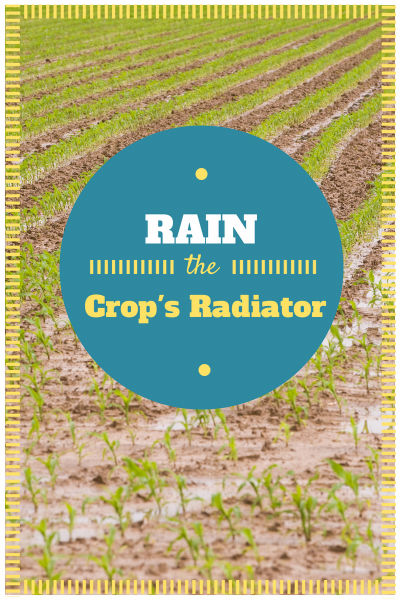
Rain - The Crop's RadiatorAre you getting weary of all the rain? Do you cringe every time you check the rain gauge or watch the local forecast? How is this weather impacting your crop?


Rainfall is one of the most important crop inputs and is also one that most farmers have little or no control over.  But many growers and crop production advisors see the role of rainfall primarily as the moisture supply that keeps plants alive.  It is akin to the gasoline in a car.  A plant needs water to operate the rest of the system.  Unfortunately, the only parts of a corn plant that can protect themselves from the heat is the leaves.  That is why corn plants take on an onion-like appearance when both temperatures and evap-transpiration rates are high and rainfall is low.  When a corn plan closes the pores in the leaves and curls the leaves inward, exposed leaf surface area is greatly reduced.  This conserves water and helps keep the leaves cooler.

Rainfall also serves a less known but far greater role than just supplying water to plants.  Water is the radiator that cools the engine of the plant, the root system.  The plant’s root system is the engine that runs the entire plant factory; unfortunately the roots have no way of protecting themselves when soil temperatures heat up.  And as long as the root system is overheating, they no longer have the ability to utilize nutrients efficiently.  It’s like the engine of your car overheating… the car eventually stops moving.  Rainfall cools the root system so it can once again properly conduct plan functions.

In 2010, as well as our current situation in 2014, many farmers across the country had more rainfall than they wanted or needed.  But most of those growers don’t realize how important that water is, even in excessive amounts.  It cooled root systems and allowed them to regain their ability to perform their proper functions.  And growers who knew the effects of cooling root systems, took advantage of getting them back to their normal function by immediately applying nitrogen.  Nitrogen is the antibiotic for both stalk rot and drought.  That means it is the main ingredient for overall plant health in a grass species like corn.

Read this article that discusses agronomic and disease issues for corn and soybean exposed to prolonged periods of high soil moisture. By Jeff Coulter, Extension Corn Agronomist with the U of M.

The number one reason why so much of the crop across the country was negatively affected by either drought or excessive water (more than it should have been) was because there were just too few applications of nitrogen to keep the plant factory running once the motor (the root system) was cooled down.  In so many cases the impact of excessive water would have been lessened greatly if that key additional coolant for that radiator would have been added repeatedly.

Fields where nitrogen was applied 4-5 time throughout the season yielded up to 80 bushels more per acre vs. those that went untreated.  Nitrogen not only allow the plant to stay healthy, it also helps the plant better utilize water for the development of grain.  Rainfall keeps plant root systems operative at critical temperature (65-86 degrees); the key to proper function.  Until a plant’s root system is operating normally, nothing you or the environment does really matters.

Do you feel differently about the rain now…maybe just a little bit?


« Previous Page
Next Page »