General

We are pleased to announce the Corn Capital Innovations Scholarship recipients for 2013!

“A Great Hand in Farming” Ag Scholarship
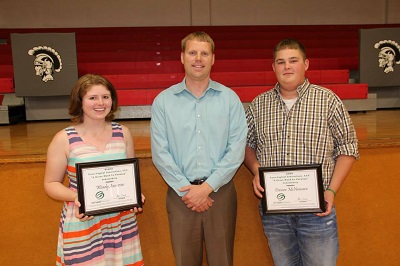
scholarship winnersThis scholarship is a contribution to the youth of rural areas who are inspired to seek opportunities in agriculture. We feel agriculture surrounds us all in some way either directly or indirectly and we want to help individuals become successful in their agricultural goals.  Our 2013 scholarship recipients are:

Wendy Anderson
$1,000 “A Great Hand in Farming” Ag Scholarship

From: Bird Island
College Plans: Augsburg College
Major: Music Business

Goal: My goal is to be successful.  I want to make my parents proud and make them feel like they succeeded in raising me.  I want to have a career that I love and enjoy and that can also change someone else’s life in some way, shape, or form.

What community or school activity has been the most meaningful: I have been in 4H for 13 wonderful years of my life.  Without this program, I would be nothing.  I probably would not have developed efficient interviewing/speaking skills.  I also would not have been able to work with different age groups, young and old, and be able to bond with them by helping them with 4H projects or fun activities.  4H has given me skills that I will need in the future.  4H exists to create leaders in this world who use their head, hearts, hands, and even their health to guide them in a successful direction.  I have gained so many connections throughout this organization.  In all honesty, I probably would not have been in an organization like FFA, which has strengthened my skills even further, if I had not been in 4H.  The people I have interacted with in 4H have inspired me to be the best that I can be.  I will use the skills I learned to help further me in the world of business in order for me to interact with others to successfully complete the task at hand.  I have been dreading the day in which my membership in 4H will come to an end, but I hope to be able to be involved with the organization when the time is right.

Connor McNamara
$500 “A Great Hand in Farming” Ag Scholarship

From: Bird Island
College Plans: NDSU
Major: Agronomy

Goal: My goals in life are to attend and graduate college at NDSU in Fargo with a degree in agronomy.  I will later use my degree to its full potential and help out my local agricultural community.  My lifetime goal has always been to come back and run the family farm with my family and be successful at everything that I do.

What community or school activity has been the most meaningful:  The organization that has left the biggest impact on my personal and career development would be FFA.  FFA has taught me that hard work and dedication really does pay off. Over the years, I have participated in several events in the local FFA chapter.  One of these events that I really enjoyed was the pancake breakfast.   Waking up early in the morning and serving the community breakfast was well worth the loss of sleep and a whole lot of fun!


Andy McNamara Memorial Scholarship
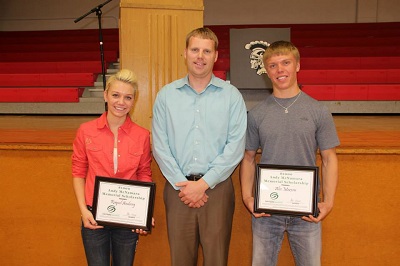
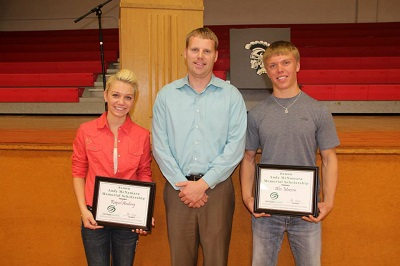
McNamara Scholarship winnersThis Scholarship is in memory of Andrew “Andy” McNamara, a Renville County farm boy who had the desire to be involved in production agriculture. He thoroughly enjoyed the outdoors and was concerned for the environment. Andy is missed by all those who knew his real passions.  Our 2013 scholarship recipients are:

Alec Marxen
$2,000 Andy McNamara Memorial Scholarship

From: Bird Island
College Plans: University of Wisconsin – River Falls
Major:  Agricultural Business

Goal:  I plan to start a career in the agriculture industry in the Bird Island area that provides me with opportunities to advance to a management/supervisor position.  I also plan to take over my family’s farm when my Dad retires.

What community or school activity has been the most meaningful:   I feel that FFA has been the most meaningful to my personal and career development.  FFA gave me the opportunity to further my knowledge about agriculture and better my public speaking skills which will be both instrumental since I am pursuing a career in agriculture.  FFA also involves lots of volunteer work and fundraisers which I feel are very important because these things require dedication and commitment while giving me an opportunity to give back to the community.  FFA has also created relationships that I feel will last a lifetime.

Raquel Amberg
$1,000 Andy McNamara Memorial Scholarship

From:  Bird Island
College Plans: South Dakota State University – Brookings
Major: Agri-Business

Goal: My goal is to go to SDSU and finish my 4 years of education there.  I plan to major in Agri-business and minor in wildlife and fisheries.  After I finish my education, I hope to come back to Olivia and help my Dad farm and soon take over the family farm.

What community or school activity has been the most meaningful:  The most meaningful things are my Dance Team and FFA.  My Dance Team is like a family and we stick together.  Dance is something that I can do to get my stress out.  It is something I have a love and passion for.  Dance has made me learn how to become a leader and a role model.  FFA is going to help me develop my career because it is teaching me things I need to learn for what I want to do.  FFA is also really fun.  It’s good to have fun while you’re working and with FFA you can work, learn and have a blast.
Top Notch Crop

To every farmer who has another crop in the ground, congratulations on a safe and successful spring.  Many people believe that spring is the start to our crop year.   However, 75 to 85 percent of your crops yield potential has already been dictated.  We know that weather is the largest factor in predicting a top notch crop, but the decisions you have made up to now also have an impact.

As you were in your fields this spring, what did you notice and what were the things you would have changed to be more prepared?  How did your combine perform last fall by spreading out the crop residue? The fall tillage? What were the field conditions as we prepared the soil for this year’s crop?

I’m Steve O’Neill with Corn Capital Innovations, and as we worked with our clients this spring, we were taking many notes on how decisions made a year ago are impacting our crop this year.   As we watch this crop emerge, grow, and develop, we will be noting the differences and how management choices can relieve the stress on the plant.   We understand the plant is telling the story of its nutrient needs and environmental stresses.

Are we on pace to double our production in the next 20 years using the same practices and tools we are using today?  Here at Corn Capital Innovations, we are working diligently to make sure we are on the path to achieving our goals.

What have you noticed about this year’s crop so far?

Drone Farming

What is your first thought when you hear the word drone? If you are like most Americans and follow any sort of mainstream media, your first thoughts probably migrate to the military’s use of these vehicles for surveillance or even running bombing raids in foreign countries. Law enforcement agencies are also beginning to utilize the use of drones in surveillance of rural areas, namely public grounds, in search of illegal operations in the drug trade.

The Unmanned Arial Vehicle’s (or simply UAV as defined by the military) biggest potential in agriculture is the aerial images and data acquisition that can be obtained at a much lower cost than traditional forms that have been utilized in the past.  When we look to the future of farming specific to technology, one must always look at what our military is using.

More times than not, the technology that we have to utilize on our farms are a direct descendant of research and development in our military. When the Russians entered space in 1957 with the first satellite, Sputnik I, the space age began.  This triggered major investments by the U.S. military in technologies that ushered in a new era of scientific discovery and development. The Global Positioning System (GPS) was developed in the 1970’s, became available to the public in the late 1980’s, and currently is utilized numerous times a day on several different platforms by the American public.

If you were farming in the 1950’s, would it ever have occurred to you that an event such as the Sputnik I would lead to having sub-inch accuracy while planting a field in which the tractor would steer itself?
Drones have come under scrutiny recently in the states by groups such as the American Civil Liberties Union in regards to their use and their possible infringement on people’s privacy. Google’s CEO, Eric Schmidt, has entered the foray in stating that “the use of cheap, miniature, “everyman” drones need to be banned by international treaties before such devices fall into the hands of private users including terrorists.”
Why all the attention on drones? A federal law mandates that the Federal Aviation Administration open up
the national airspace system by 2015. By doing so, it will present the opportunity for people to not only purchase, but to also utilize drones for commercial use. Currently, it is against the law to use or fly a drone as the airspace is controlled by the FAA.

In a study released by the Association for Unmanned Vehicle Systems International (AUVSI), they predict that from 2015 to 2025, the UAV industry could produce up to 100,000 new jobs and add upwards of $80 billion in economic activity. Michael Toscano, CEO of AUVSI, has stated that “eighty percent of utilization of Unmanned Aircraft Systems will be used in precision agriculture.”  These are jobs and technology that can be added to the economy while not replacing human capital. While the uses remain limitless, if this technology is utilized and creates simply a 1% increase in output in agriculture in the United States, we are looking at adding billions of dollars into the economy. It is my belief that these tools will lead to more accurate and timely decisions in producing a crop.  The level of education and understanding in how to treat a crop is paramount from the air. After all, a bird’s eye view of your fields is the quickest way to see and interpret if you need to take action in your production strategies.

“…a bird’s eye view of your fields is the quickest way to see and interpret if you need to take action in your production strategies.”

Japan has used drones since the early 1990’s in their rice production. Several countries that are our biggest competitors (namely South America) are also utilizing drones for agricultural production. While the technology is here today, we may actually be the laggards in the world community in the utilization of drones. The use of drones has the potential of changing the way we farm. The only thing in the way of their wide spread utilization is the passing of legislature by the federal government in allowing the private industry to use this
technology for widespread adaptation to agricultural production strategies.

“Be Willing to Change” – Does that stop you in your tracks?

DirectionIn the latter part of Francis Childs’ life, he became accustom to receiving well over 20 phone calls a day from farmers across the Corn Belt. The most common question asked to him; What is the one thing that I can do to improve my corn yield? His response never wavered: “Be willing to change.” Francis had stated many
times that his response would stop the majority of farmers in their tracks.

“Whatever they (farmers) are doing, they just keep right on doing it and expect things to change.”

Henry Wallace, Norman Borlaug, and Francis Childs all grew up on small farms in Iowa. Wallace changed the
way we looked at breeding hybrid corn. Borlaug is the only agronomist who has received a Nobel Peace Prize for his contribution to the world food supply through his advocacy of increasing crop yields. Childs set numerous corn yield records in which his accomplishments were likened to the breaking of the sound barrier. These were very accomplished individuals that have changed the way we look at production agriculture.

Some of the key traits that these characters exhibited were not only their ability to change and adapt at an alarming rate, but also the level of competitiveness. Wallace became Vice President, Borlaug a Hall of Fame wrestler, and Childs became a champion many times over in corn yield contests.

Change

Things are constantly changing in the world we live in. Weather forecasts, soil conditions, markets, crop rotations, and management strategies are all things that are not concrete, they are always evolving. Some of these are within our control and some are not. In Simon Sinek’s book, Start With Why: How Great Leaders Inspire Everyone to Take Action, he writes in-depth in relation to how it is human nature to start
with the WHAT, then HOW, and finally WHY decisions are being made. He also talks about how this model is inherently incorrect. More times than not, we start with WHAT we are going to change, then HOW we will change it, and finish the thought process with WHY we made the change. When changes occur that are not within our control, more times than not, that change takes place quicker than any of us can adapt
to.  Sinek’s important point is that the key to dealing with change on any level, whether it be your life, your operation, or management practices, is starting with the question as to WHY you are making the change. What is it that motivates you to do what you do and why you do it? Is it the competitive nature of the agricultural community? Is it the ability to pass on a legacy to future generations? Is it the competitive  nature that you have within yourself to consistently achieve greater yields?

“There are no miracles in agricultural production.” – Norman Borlaug

Francis Childs planted his corn crop at 2 MPH, used tillage practices that were out of the norm, and spent almost every day of the growing season in his corn fields analyzing nutrient deficiencies and adjusted accordingly as needed.  Norman Borlaug is credited as, “The Man Who Saved A Billion Lives” with his in-depth research in the world wide utilization of wheat to fight hunger. Henry Wallace is remembered as the Father of Modern Agriculture who, as Oriville Freeman wrote, “never feared controversy, for his constant purpose was to do things which make life worthwhile.” The only constant in a successful farming operation is change. Success comes down to the commitment of being open to change. As you continue your farming operation practices, please keep in mind that the WHY, HOW, and WHAT you do on your farm have a profound impact on all facets of life in our world.

Important Crop Insurance Dates for Late Planting

Important Crop Insurance Dates

Late Plant Dates
Corn = May 31
Sugar Beets = May 31
Soybeans = June 10

CROP INSURANCE ACREAGE REPORTS ARE DUE NO LATER THAN 7- 15- 13

Early Reporting to your Crop Insurance Specialist will:

  • Expedite FSA Reporting: Simply meet with your agent to complete the acreage report and take a copy with you to the FSA office
  • Speed up the claims process in the event of replant or prevented planting claims

Contact us today if you have any questions on crop insurance!


« Previous Page
Next Page »